📥 Apply now: [link]
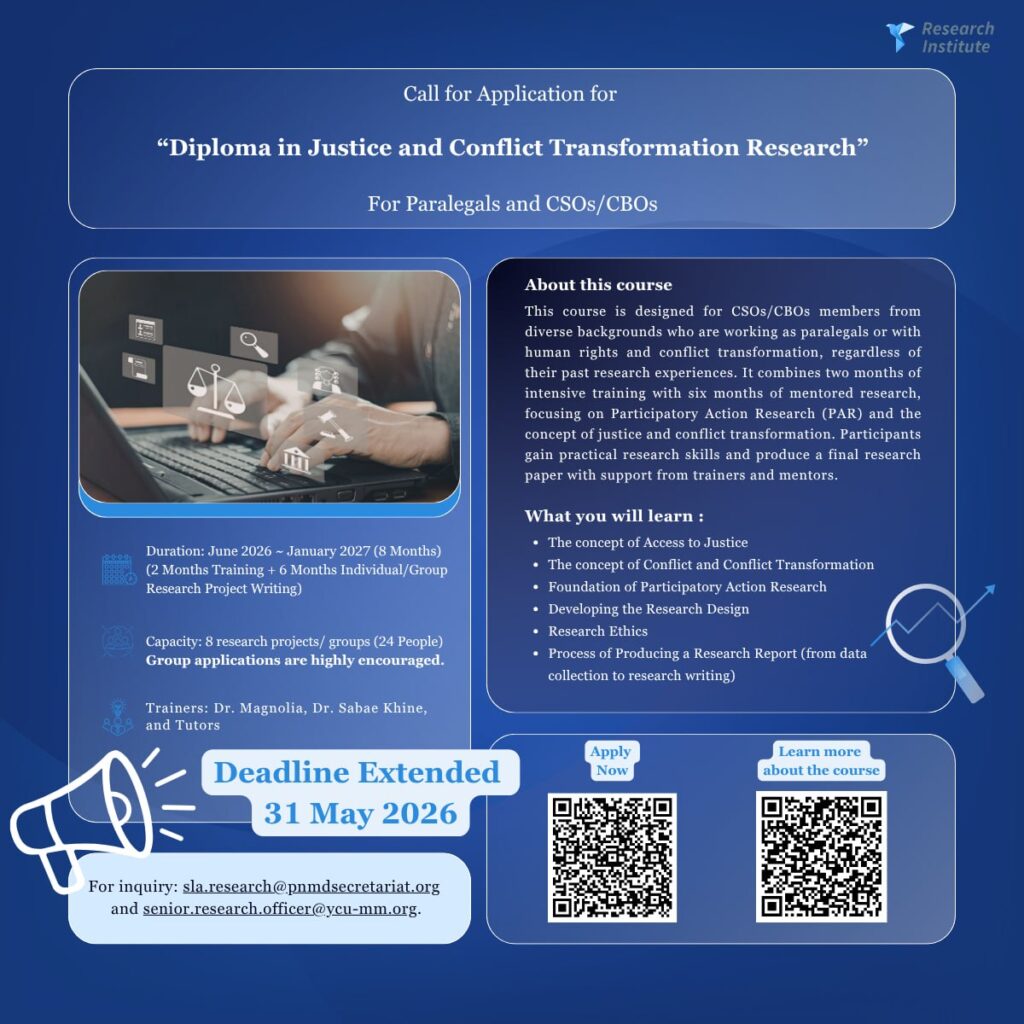
🎓 Diploma in Justice and Conflict Transformation Research
📅 New Deadline: 31 May 2026 (Sunday)
For Paralegals and CSO/CBOs
Applications are now open for a specialized diploma program designed for Paralegals and CSO/CBO members working in human rights and conflict transformation.
🔹 Duration: June 2026 – January 2027 (8 months)
🔹 Structure: 2 months intensive training + 6 months mentored research
🔹 Focus Areas: Participatory Action Research (PAR), justice, conflict transformation, and research design
🔹 Outcome: Practical research skills + final research paper with mentorship
🔹 Capacity: 8 research projects (24 People)
Group applications are highly encouraged.
Scan the QR codes in the poster to apply or learn more.
———————————————-
Course Description
This course is designed to enhance CSOs/CBOs members’ knowledge and capacity on Participatory Action Research (PAR). The course will be tailored for CSOs/CBOs from diverse contextual backgrounds and who are working as paralegals, or on human rights, and conflict transformation (hereafter the researchers). To ensure the course results in tangible community impact, the program develops clear objectives and targets with the participants, alongside a monitoring plan, and provides a small stipend to support internet, printing, and other costs. We aim to produce 8 research projects, with each project receiving a small stipend, and receiving mentorship, e-library access, and advice on different publication platforms responding to the research. These projects will last for 8 months and will be launched in June 2026, and are expected to reach completion by the end of January 2027, allowing researchers to apply their classroom learning to real-world outcomes.
This course aims to guide the researchers towards achieving competence and proficiency in the concept of justice and conflict transformation and the practice of participatory action research. To achieve the aims, the syllabus will explicitly account for the varying levels of formal research experience among participants, recognizing that many may lack traditional academic training, and to ensure the skills developed are both accessible and practical for their field work. The course emphasizes critical analysis and important ethical considerations, ensuring that participants can develop clear research objectives and apply their findings directly to their community work by applying their research knowledge and skills. It has a total of 8 sessions for 16 hours. Each session will be mixed with lectures and discussions.
There are 8 modules in this course:
- The concept of Access to Justice
- The concept of Conflict and Conflict Transformation
- Foundation of Participatory Action Research
- Developing the Research Design
- Research Ethics
- Process of Producing a Research Report (Data Collection)
- Process of Producing a Research Report (Data Analysis) and
- Process of Producing a Research Report (Reporting)
Learning Objectives
The primary objective of this course is to equip the researchers with a comprehensive understanding of the legal and social mechanisms required to facilitate Access to Justice and Conflict Transformation through the lens of Participatory Action Research (PAR). The researchers will learn to design and execute community-based research projects that empower Civil Society Organizations (CSOs) and paralegals to drive systemic change.
Learning Outcomes
At the end of the course, the researchers will be able to
- Define and analyze the barriers—socio-economic, physical, and systemic—that prevent marginalized populations from accessing legal remedies.
- Differentiate between conflict resolution and conflict transformation, identifying how to address root causes rather than just immediate symptoms.
- Assess the specific methodologies used by Civil Society Organizations and Community-Based Organizations to build sustainable peace and social cohesion.
- Explain the philosophical foundations of PAR, focusing on the shift from “researching on” people to “researching with” them.
- Construct a robust research design that integrates community participation at every stage of the inquiry process.
- Navigate complex ethical landscapes, ensuring informed consent, anonymity, and the protection of vulnerable participants in a field setting.
- Execute the full lifecycle of a research project, from systematic data collection and qualitative/quantitative analysis to the final production of a comprehensive research report.
Course Instructors
The course will be delivered by the Senior Research Adviser of the YCU, the Senior Technical Adviser, and six instructors. All instructors are experienced in teaching and research in the field of human rights, law, conflict, and peace studies.
Teaching and Learning Methods
Delivery Methods
This course is fully online, and Zoom will be used for live teaching sessions. YCU-LMS is the main platform for sharing reading materials and assignments. Reading materials will be shared by the Research Institute Assistants before the class. Meanwhile, students are also encouraged to search via different search engines.
- Lectures (Virtual): Each session will include interactive presentations and Q&A segments.
- Group Discussions: Students will collaborate to evaluate case studies and research problems.
- Practical Exercises: Hands-on activities for skill development, such as developing a research design, identifying the risks, and mitigation plan.
Expectations from Participants
- Attend at least 75% of classes.
- Actively participate in discussions and group exercises.
- Submit assignments and projects on time.
- Completed the YCU research ethics course before Week 5 (Access Here: Link).
Assessment Criteria
- Attendance: 10%
- Participation: 10%
- Participants understand the research process and knowledge under the sensitive environment and produce non-academic (15-20 pages) research output (80%).
Schedule
| Week | Module | Instructor |
| Week 1 | The Concept of Access to Justice | Nwe |
| Week 2 | The Concept of Conflict and Conflict Transformation | Lilly |
| Week 3 | Foundation of Participatory Action Research | Felicita |
| Week 4 | Developing the Research Design | Magnolia + All instructors |
| Week 5 | Research Ethics | EP |
| Week 6 | Process of Producing a Research Report I: Preparation for Data Collection | TDC |
| Week 7 | Process of Producing a Research Report II: Data Analysis | KML |
| Week 8 | Process of Producing a Research Report III: Reporting | SBK |
| Six months | Research Writing | ALL mentors |