
Author:Alom Shah
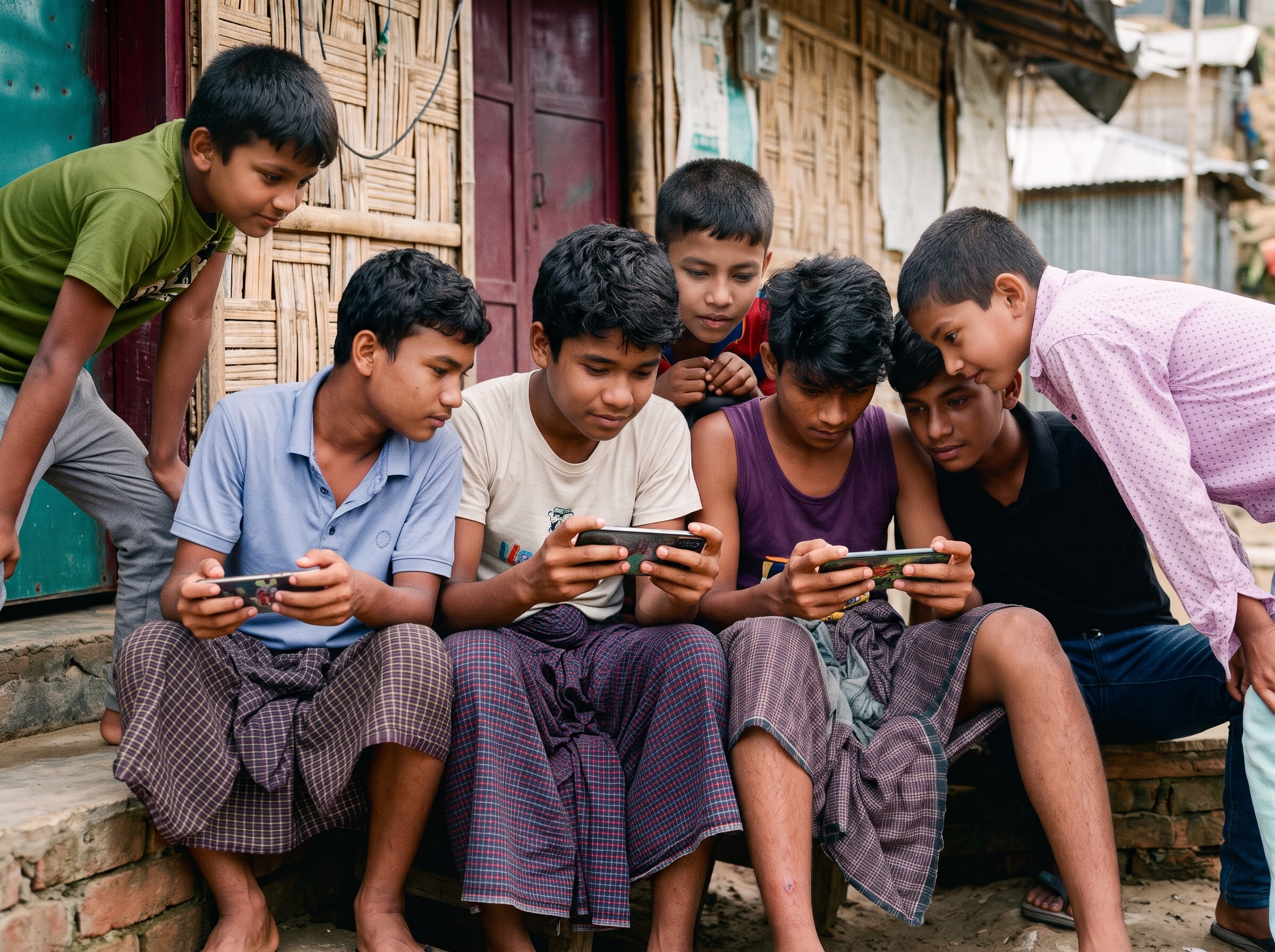
At a time when a refugee community faces deep political and social issues with limited career opportunities, education plays one of the most important roles in shaping a sustainable future that includes dignity, hope, and knowledge (Ehlers, 2024; UNHCR, 2024). As a teacher in a Rohingya refugee camp for almost a decade, children’s learning environment is increasingly troubled by the excessive use of mobile phones as they continue to get more digital access. Certain uses of digital devices in academic learning is very helpful for the students as they can learn from educational videos, do research, access digital textbooks, and practice languages. However, the students are more likely to be addicted to social media, doomscrolling and playing online games as they continue to use smartphones very often. As a result, this addiction is deteriorating students’ concentration in studies, cognitive development, and academic performance (Amez & Baert, 2020). Without clear parental guidance, excessive use of smartphones becomes deeply problematic and a source of distraction rather than helping in academic studies. Amidst the adult refugees’ hardship, parental responsibility is very important to manage their children’s screen time in a more balanced way in order to keep their attention and concentration on their studies. Thus, this shows the urgency to better examine the current issue in the refugee camp for a more ethical and responsible use of smartphone and social media to keep the students’ character, attention, and academic performance on the right track.
The human brain is designed for short-term and long-term memory retention. This memory design is believed to help learners effectively with sustained attention and transfer information from working memory into long-term memory. However, engaging more in social media applications creates cognitive overload, as students become addicted to doomscrolling rather than learning or academic performance (Gadosey et al., 2024). Hence, this kind of addictive behaviour slows down their intellectual growth and makes it increasingly difficult to focus on their academic work. Besides, this is particularly concerning for adolescent students who are in a stage of their cognitive development. During adolescence, experience, and learning can help and develop connections between neurons, while some unused connections are gradually removed through a process called synaptic pruning. The brain’s ability to change and reorganize in response to experiences is known as neuroplasticity (Margetis & Vadakekut, 2026). In simple terms, neuroplasticity is like building and improving bridges between brain cells, helping the brain adapt to new experiences and learning. A healthy system of neuroplasticity supports critical thinking, problem-solving, and self-adaptation, however many students tend to focus on temporary gratification and pleasure from excessive use of social media rather than focusing on their natural ability to learn and adapt (Margetis & Vadakekut, 2026)
As this issue continues affecting students’ personal and academic growth, it has become a rising concern for the teachers. For example, many students spend late-night scrolling social media and that deprived of sleep negatively affects their ability to concentrate, mental well-being, and readiness to attend the morning classes. Teachers know this the best: a student with a tired brain cannot learn efficiently, no matter how dedicated and bright they are . For the Rohingya students, these challenges will remain unaddressed unless an action is taken by the parents, community, and teachers. Limited educational resources, years of displacement, and uncertainty about the future have already positioned them in a cycle of struggles. In the midst of all these challenges, education should become their top priority rather than misusing their valuable times on social media. This does not mean the use of mobile phones should be banned for them, rather the parents should limit their excessive use and encourage them to spend their free time with friends, helping with housework, and participating in other extracurricular activities.
As social media continues to grow and help us in our daily settings, there are also some serious consequences that we overlook and do not take seriously. Having faced injustice and deprived of opportunities for generations, most of the Rohingya parents are less educated and have limited understanding about the negative sides of social media. To be fair, parents themselves also use social media extensively amidst dealing with general hardships posed by refugee life. As a result, some parents seem to be strict while some others seem to be flexible in letting their children have a smartphone and use social media. This is because some parents think their children can learn something meaningful if they have a smartphone and access to social media while some others think their children will not focus on their academic work if they get a smartphone. In this case, the parents should understand the purposeful digital use and cooperate with the teachers to establish a balanced way of using social media. For example, they can focus on children’s ability to concentrate by limiting daily screen-time, encouraging devices for free study period, keeping a track on their online activities, and promoting offline learning (Korie, 2025). So, when parents and teachers work together, they can enhance awareness of the cognitive and educational consequences of excessive screen use while applying strategies for supervising children’s digital lives.
Moreover, the future of the Rohingya refugee learners depends on more than classroom, textbooks or humanitarian assistance. It depends on re-thinking how students can think deeply, concentrate fully, and learn effectively. Daily digital engagement that interrupts a lesson and every unnecessary hour spent scrolling affects a child’s educational future and also his actions will create negative consequences in the society. Every parent has the power to change these children’s online behaviour. By setting thoughtful digital limitations today, parents can improve their educational performance, cognitive skills, and ensure that technology serves education instead of replacing it. In a community where opportunities are limited, protecting a child’s attention may be one of the greatest investments in their future.
References
Amez, Simon, and Stijn Baert. 2020. “Smartphone Use and Academic Performance: A Literature Review.” International Journal of Educational Research 103: 101618. https://doi.org/10.1016/j.ijer.2020.101618.
Ehlers, A. 2024. “The Role of EdTech in Enhancing Access to Education for Rohingya.” Bachelor’s thesis, University of Twente. https://essay.utwente.nl/fileshare/file/101623/Ehlers_BA_BMS.pdf.
Gadosey, Pius I., Yang Liu, Yan Lin, et al. 2024. “Mobile Phone Addiction and Academic Procrastination in Adolescents: The Serial Mediating Roles of Self-Regulation and Psychological Resilience and the Moderating Role of the Parent-Child Relationship.” Brain and Behavior 16 (1): e71169. https://doi.org/10.1002/brb3.71169.
Korie, Daniel. 2025. “Digital Technology, Perceived Parental Mediation, and Adolescents’ Academic Performance.” Advances in Social Sciences Research Journal 12 (6): 189–206. https://doi.org/10.14738/assrj.1206.18991..
.
About the Author
Alom Shah is a junior student studying Data Science at Parami University with a deep passion for the liberal arts education. As a dedicated research fellow, community leader, and educator, Alom bridges technical analytical skills with humanistic inquiry and technological solutions to empower his communities and beyond. His work focuses on leveraging data-driven insights and education to drive meaningful social impact.